

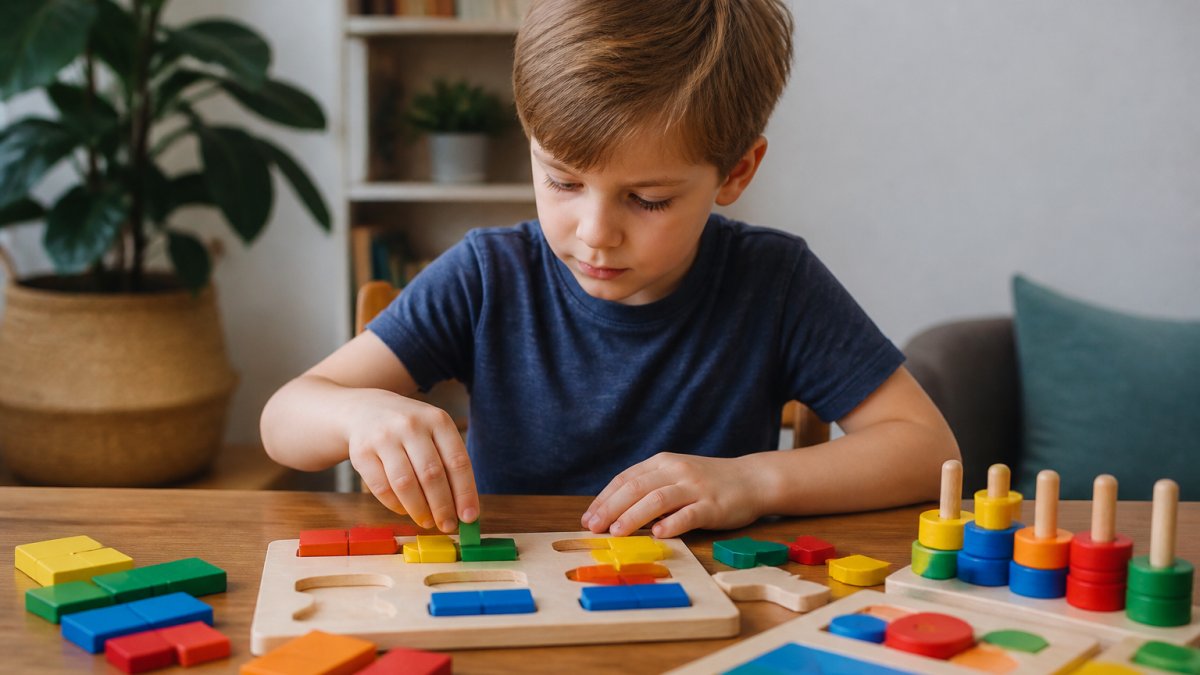
Last Updated: October 22, 2026
Quick Summary
Educational games are structured play activities with a learning goal, such as building memory, practicing reading, or managing emotions. They work for kids with ADHD because attention, movement, and feedback arrive in short bursts, matching how these children focus best. Keep sessions to 10 or 15 minutes and end on a win.
- Educational games have three parts: a clear learning target, simple rules, and understandable feedback.
- Memory match starts with 8 cards for younger kids and adds more as they improve.
- Ten minutes of movement before homework often works better than a lecture about sitting still.
- Practice calming games when the child is already calm, not during a meltdown.
- Keep cooperative game groups small, three or four kids at most, and set rules out loud first.
Table of Contents
- Why Educational Games Fit How Kids With ADHD Learn
- Attention and Focus Games That Build Working Memory
- ADHD Activities for Kids That Channel Energy and Movement
- Calming Activities for Kids With ADHD: Self-Regulation Through Play
- Social Skills, Role-Play, and Cooperative Games
- Free ADHD Games Online: What to Check Before You Click
- Matching Games to Age, Reading Level, and Sensory Needs
- Frequently Asked Questions
Why Educational Games Fit How Kids With ADHD Learn
Educational games for kids with ADHD work because they turn learning into something the brain wants to chase. At Dewey Does, we have been igniting curiosity and making learning an adventure for children since 1999.
Educational games are structured play activities with a learning goal, such as building memory, practicing reading, or managing emotions.
A coloring page is creative; a memory-matching card game with turn-taking rules is an educational game. Both belong in a child’s day, but only one trains working memory on purpose.
Pick games by the skill they build, not by how busy they keep a child. A quiet matching game can do more for focus than an hour of free play.
Educational Games vs. General Activities: What’s the Difference
Educational games have three parts: a clear learning target, simple rules, and feedback the child can understand. General activities like free drawing support development but do not target a specific skill. Label each game with the skill it builds so you can repeat the ones that work.
Attention and Focus Games That Build Working Memory
The best attention games are short, rule-based, and slightly hard. Working memory is the mental workspace that holds information while a child uses it, and games that ask a child to remember, sort, or sequence train it directly.
A starter set:
- Memory match. Lay out 12 cards face down. The child flips two at a time to find pairs. Start with 8 cards for younger kids and add more as they improve.
- Simon-style sequences. Tap a pattern of three sounds or movements. The child repeats it and adds one. Stop at the first sign of frustration.
- Sorting races. Give a mixed pile of buttons or blocks and a timer. The child sorts by color, then shape, then size.
- Story recall. Read a short page, then ask three specific questions about it.
Keep sessions to 10 or 15 minutes. End on a win, not on a mistake.
Let the child set the difficulty. Ask, “Should I make the next pattern longer or keep it here?” Giving kids control over challenge keeps engagement high and reduces the meltdowns that come from sudden failure.
ADHD Activities for Kids That Channel Energy and Movement
Movement is not a break from learning. For many children with ADHD, it is the condition that makes learning possible. Short movement breaks between seated tasks help kids return to work calmer.
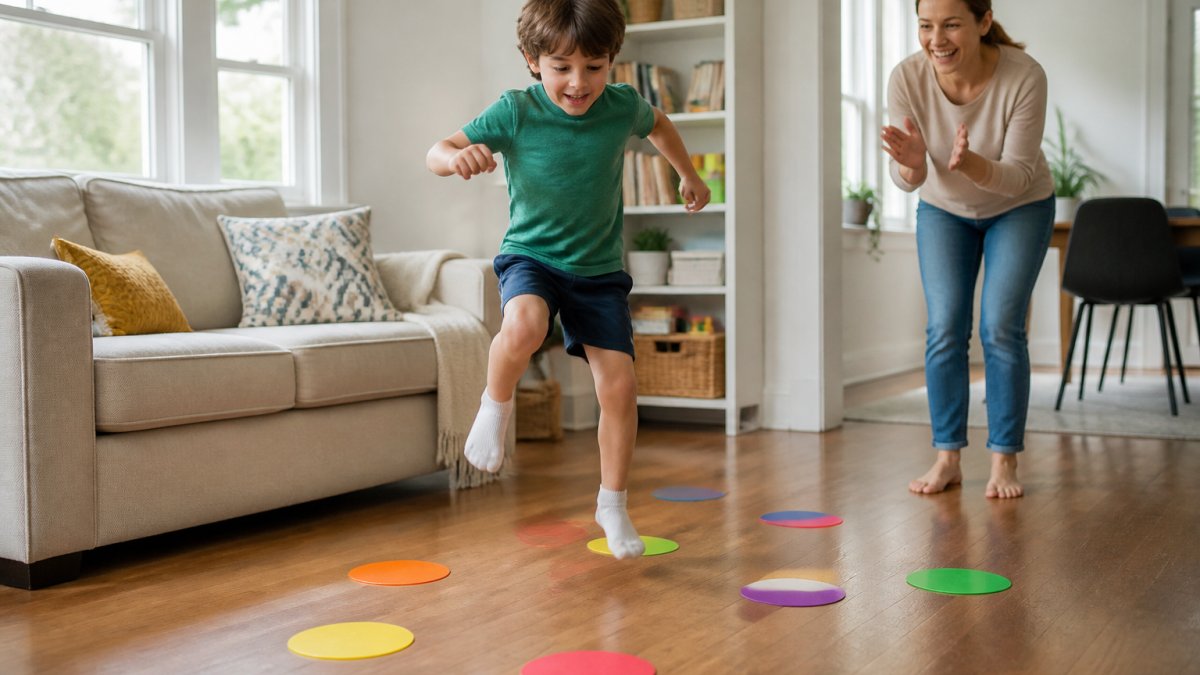
Try these ADHD activities for kids that burn energy while teaching something:
- Alphabet hop. Tape letters to the floor. Call a letter and have the child jump to it.
- Math relay. Place number cards at one end of the room. Call a simple sum and have the child run to fetch the answer.
- Freeze dance with rules. Music plays, bodies move, music stops, bodies freeze. Add a rule like “freeze in a shape with three sides.”
Ten minutes of this before homework often works better than a lecture about sitting still.
Calming Activities for Kids With ADHD: Self-Regulation Through Play
Calming activities for kids with ADHD teach the body to settle before big feelings take over. Self-regulation improves with practice during calm moments, not during a crisis.
Timing matters most. Practice calming games when the child is already calm; a child who has played “slow breathing races” a dozen times on a good day can reach for that skill on a hard one.
Reliable options include:
- Breathing games. Blow a cotton ball across a table with one long breath. Slow exhales settle the nervous system.
- Sensory bins. Rice, sand, or water with scoops gives hands something to do while the mind slows.
- Weighted or deep-pressure play. A heavy blanket or a gentle “sandwich” squeeze between cushions helps some kids feel grounded.
Never force a calming activity mid-meltdown. A dysregulated child often reads touch and instructions as threats. Offer the option, keep your voice low, and let the child choose.
Social Skills, Role-Play, and Cooperative Games
Cooperative games build the skills ADHD makes hardest: waiting, turn-taking, reading social cues, and losing without falling apart. Role-play adds another layer because the child practices a script before using it in real life.
Board and card games are excellent here: Uno teaches turn-taking, charades teaches attention to others, and simple role-play like “order at a restaurant” lets a child rehearse a social script safely.
Keep groups small, three or four kids at most. Set the rules out loud before starting. Name the social skill being practiced, such as “this round we practice waiting for our turn without interrupting.” Praise the behavior you want to see more of.
Free ADHD Games Online: What to Check Before You Click
Most roundups of educational games for kids with ADHD either ignore digital games or wave at them with a vague “check the app store,” leaving families guessing about ads, subscriptions, data collection, and whether a game teaches anything. This section names the categories worth considering, explains what “free” usually means, and gives you a five-minute screening routine.
The three kinds of digital games you will encounter
1. Open-source or public-domain learning games. Simple memory, matching, or math games built by educators or nonprofits, with no ads and no account requirement.
2. Freemium apps with a paid tier. The download is free, but the full game sits behind a subscription or one-time unlock, often via daily level limits, locked content packs, or an ad-free upgrade.
3. Ad-supported games. Free because advertisers pay, with a hidden cost in attention: banners, interstitials, and reward videos compete with the learning goal.
A five-minute screening routine
Run this before you hand over a tablet:
- Learning target. Can you state in one sentence what skill the game builds? If the answer is “it keeps them busy,” it is entertainment, not an educational game.
- Session endpoint. Does the game have a natural stopping point, or does it loop endlessly? Games with levels, rounds, or a clear “you finished” screen are easier to time-box.
- Ad model. Are ads present, and are they age-appropriate? Check whether ads appear mid-level or only between levels.
What federal privacy rules actually cover
Apps directed at children under 13 fall under the Children’s Online Privacy Protection Act (COPPA), enforced by the Federal Trade Commission.
The Federal Trade Commission’s guidance on children’s privacy explains what protections apply and how to file a complaint if an app appears to be collecting data from kids without consent. When you screen an app, look for a privacy policy written in plain language and a statement of COPPA compliance.
Screen time: purposeful versus passive
The goal is not to ban screens but to make screen time purposeful. A game with a clear learning target and a defined end point differs from an endless feed. A workable pattern many families use:
- Set a timer for 15 to 20 minutes and stop when it rings, not when the child loses interest.
- Play alongside your child when you can, and narrate the skill: “You just held three numbers in your head. That is working memory.”
- Follow up with an offline version of the same skill. If the app practiced sorting, sort real buttons at the table.
Ask the child to teach you the game afterward. Explaining a rule out loud is a memory and language workout, and it tells you whether the game actually taught something.
A note on brain-training claims
Some apps market themselves as improving attention or reducing ADHD symptoms. Be skeptical: research on computerized brain training is mixed, and most studies show improvement on the trained task rather than transfer to schoolwork or behavior. A game can be a useful practice tool for a specific skill, but it is not a treatment. If an app promises to “fix” attention, that is a marketing claim, not a clinical one.
Matching Games to Age, Reading Level, and Sensory Needs
The right game fits three things: the child’s age, reading level, and sensory profile. Too easy bores a bright child; too hard triggers avoidance. Match the challenge to the child, not the age on the box. The table below gives a starting point; the notes after it explain how to adapt each game type.
| Age Range | Best Game Types | Session Length | Materials | Adaptations |
|---|---|---|---|---|
| 3-5 | Matching, sorting, movement songs | 5-10 minutes | 8-12 picture cards, colored blocks, tape | Fewer pieces, picture-only rules, one instruction at a time |
| 6-7 | Memory match, alphabet hop, simple board games | 10-15 minutes | 12-16 cards, floor letters, one board game | Visual cue cards, turn-taking prompt card, partner play |
| 8-9 | Strategy card games, role-play, timed sorting | 15-20 minutes | Card deck, timer, scenario cards | Written rules, scorekeeping role, choice of timer on or off |
| Mixed ages | Cooperative games, relay races | 10-15 minutes | Cones or markers, shared goal chart | Pair older with younger, assign roles, no elimination |
Reading level: the hidden mismatch
Reading level matters as much as age. A child reading below grade level needs picture-based rules and spoken instructions. A child reading above grade level can handle written rulebooks and strategy games.
A practical fix: read the rulebook yourself first and rewrite the rules as three numbered steps in plain language. Keep the rewritten card in the box. If the child can read the three steps aloud, the game is at the right reading level. If not, swap in a picture-based version or play as a team.
Sensory profile: match the setting, not just the game
Sensory needs shape the setting as much as the game. Some children need quiet rooms and low light; others focus better with background noise. Watch how your child responds and adjust the environment before blaming the game. Three dimensions to check:
- Sound. Games with buzzers, timers, or loud celebration sounds can overwhelm a sound-sensitive child. Mute the device or choose a silent version. For board games, replace a buzzer with a hand raise.
- Visual stimulation. Busy boards with many colors and small print raise the load. Choose games with large, high-contrast pieces and a clean play area. Clear the table of unrelated items before starting.
- Movement and touch. Some children need to move while thinking. Allow standing, a wiggle cushion, or a fidget in one hand while the other plays. Deep-pressure options, like a weighted lap pad, help some children stay seated longer.
Co-occurring needs and frustration tolerance
ADHD often travels with other needs, and the game should flex for them. For a language delay, choose picture prompts and model the sentence you want (“I want the red one, please”). For fine-motor delays, swap small pieces for larger ones or use card holders.
Do not use the age on the box as the only guide. A 7-year-old reading above grade level may need an 8-9 game with rewritten rules, while a 9-year-old with sensory sensitivities may do better with a 6-7 game in a quiet room. Fit the child, not the label.
For a broader look at how play supports development, the American Academy of Pediatrics’ report on the power of play is a useful starting point for parents.
We built our own games and puzzles at Dewey Does with these adaptations in mind, so a single household can serve a 3-year-old and an 8-year-old from the same collection. If you want to see how that works in practice, browse the Centers for Disease Control and Prevention’s ADHD resources for parents alongside our activity library.
Frequently Asked Questions
What kinds of educational games work well for kids with ADHD?
Short, rule-light games with clear visual cues tend to work best. Look for rounds under 10 minutes, a single objective per turn, and immediate feedback so attention doesn’t drift. Memory-matching card games, sorting races, rhythm clapping, and cooperative board games all fit that pattern. Kids with ADHD often do better when they can move between turns, so games that build in standing, stretching, or handing off a token keep focus higher than games that require long sitting. Rotate three or four favorites rather than buying new ones constantly.
How can I adapt a game to help a child with ADHD stay engaged?
Change the structure, not the goal. Break a 20-minute game into four 5-minute rounds with a movement break between each. Put the rules on a card with pictures so you don’t have to repeat instructions. Let the child be the scorekeeper or timer, which gives restless hands a job. Reduce the number of pieces or cards in play so the setup isn’t overwhelming. If a game stalls, shorten it rather than pushing through, and end on a win so the child wants to come back to it.
Do brain-training games help children with ADHD?
The evidence is mixed. Brain-training apps can improve performance on the specific task they drill, but research has not consistently shown those gains carry over to schoolwork, homework habits, or classroom behavior. Treat them as one small piece of a plan, not a treatment. Games that combine movement, social interaction, and real-world problem-solving tend to produce broader benefits than screen-only drills. Talk with your child’s pediatrician or school team before relying on any game for attention or behavior goals.
Are free ADHD games online safe and worth using?
Some are, but check three things first. Look for a clear privacy policy that says whether data is collected from children, since the Children’s Online Privacy Protection Act limits what sites can gather from kids under 13. Check whether ads appear mid-game, which pulls focus. And test the game yourself for a few minutes to confirm it loads without freezes. Set a timer before your child starts, since free games often have no natural stopping point. A short session with a clear end works better than an open-ended one.
Every child with ADHD learns differently, and finding games that hold attention for more than a week takes trial and error. Dewey Does makes that search easier with engaging educational cartoon characters, a diverse range of learning activities including games, puzzles, and coloring, and a learning-first approach we have refined since 1999. Explore the collection and give your child a game they will actually want to come back to. Shop now and turn playtime into progress.