

Last Updated: October 23, 2026
Quick Summary
The best math games for 5 year olds match the child’s real skill level, teach one clear skill like counting or addition, and stay short at ten to fifteen minutes. Choose games a child can play with little adult help and end on a win.
- Keep sessions to ten to fifteen minutes and stop while your child still wants more.
- A five-year-old should learn a game in one sentence, with rounds of two to four minutes.
- Dice races, number hunts, and card matches teach counting with almost no setup.
- Turn off in-app purchases before handing over a phone, since a child can trigger a charge in seconds.
- Start with counting, move to number recognition, then addition and subtraction with objects.
Table of Contents
- Why Math Games Work for 5 Year Olds
- How We Picked the Best Math Games for 5 Year Olds
- Math Games for Kindergarteners: Counting and Number Recognition
- Online Math Games for Kids: What to Look For
- Free Math Games for Kids That Teach Addition and Subtraction
- Screen-Free Math Activities for Preschoolers and Five-Year-Olds
- Building Skill Progression and Confidence
- Conclusion
- Frequently Asked Questions
Why Math Games Work for 5 Year Olds
Five-year-olds learn math best through play, not worksheets. At Dewey Does, fun comes first, and skill follows. A game turns counting into a challenge kids want to win, which makes them practice without noticing.
What a 5-Year-Old Should Practice
- Counting to 20 and beyond
- Number recognition from 1 to 10
- One-to-one matching (one button, one number)
Keep sessions short. Ten to fifteen minutes works well for most five-year-olds. Stop while they still want more, and they’ll come back ready. The best math games for 5 year olds respect that short attention span.
How We Picked the Best Math Games for 5 Year Olds
We judged every game on five things. First, does it fit a five-year-old’s real skill level, not a vague age band? Second, can a child play it with little adult help? Third, does it teach a clear skill like counting, addition, or patterns? Fourth, is it safe and free of surprise costs or ads? Fifth, is it actually fun enough to play twice?
A common mistake is buying games that look educational but ask too much too soon. A five-year-old who can’t yet count to 10 will quit a game built around addition. Match the game to the child, not the box.
Watch your child play once before you buy or download anything. If they need you to explain every step, the game is too hard. If they finish without thinking, it’s too easy. Aim for the sweet spot where they need a little help.
Math Games for Kindergarteners: Counting and Number Recognition
Counting and number recognition are the foundation skills for five-year-olds, and the good news is that the best games for this stage are the cheapest ones. Dice, cards, and a handful of small objects beat most apps because they let a child see, touch, and move the numbers. The goal at this age is not speed or memorization. It is one-to-one matching (one object, one number word), stable counting order, and recognizing numerals 1 through 10 on sight, with 11 through 20 as a stretch goal.
Here is what to look for in any counting game before you play it:
- Few rules, one skill. A five-year-old should be able to learn the game in one sentence. If you need a rulebook, it is too complex for this stage.
- Visible quantities. Dots, fingers, or objects let the child check the answer by counting rather than guessing.
- Short rounds. A round should finish in two to four minutes so a ten- to fifteen-minute session includes several wins.
Counting and Number Recognition Games to Try
- Dice races: Roll one die, count the dots out loud, and move a token that many spaces on a simple track. First to the finish wins. Use a single die for beginners and two dice once counting to 12 is solid.
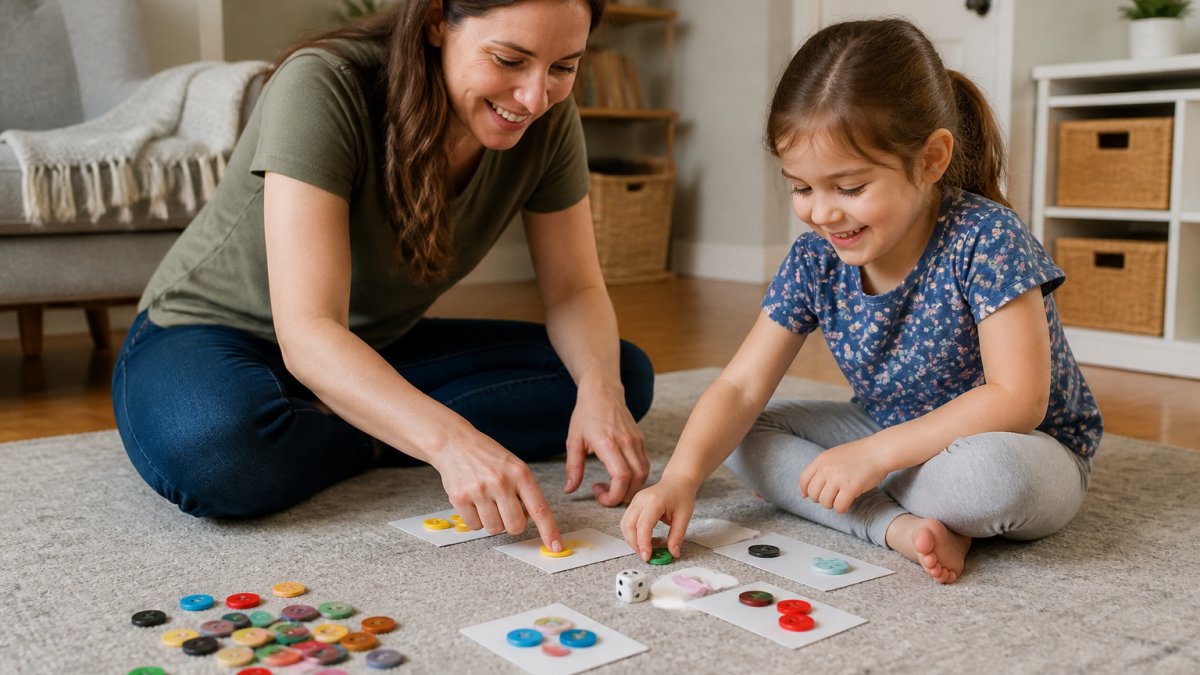
- Number hunt: Hide cards numbered 1 through 10 around one room. Your child finds each card, names the number, and then counts out that many objects (buttons, blocks, or socks) next to it.
- Card match: Pair a numeral card with a card showing that many dots. Start with 1 through 5, then add 6 through 10 once matches come quickly.
- Count and clap: You clap a number of times; your child counts and claps back the same number. Then swap roles so the child leads.
Each of these takes about five minutes and needs almost no setup. That matters, because five-year-olds warm up fast and lose interest fast. A common pattern is that a child will play the same simple game ten times in a row and then never want to see it again, so keep two or three variations ready.
Signs Your Child Is Ready to Move On
Move from counting to number recognition when your child can count a group of objects and tell you how many without recounting. Move from number recognition to simple addition when they can look at a ten-frame with seven counters and say “three empty” without counting each square. If a game still needs you to explain every step, drop back one level rather than pushing through.
Online Math Games for Kids: What to Look For
Online math games for kids can work well for five-year-olds, but only with the right guardrails. The screen is not the problem; the problem is a game that distracts, upsells, or collects data from a child who cannot read the fine print. Before you hand over a tablet, run every app through the same short checklist.
The Five-Point Screen Test
- Does it name the skill? A good game tells you plainly whether it teaches counting, number recognition, or addition. If the description is vague (“builds math confidence”), assume it is a general practice app rather than a targeted one.
- Does it adjust to your child’s level? Look for a placement step or a parent setting that starts at numbers 1 through 10. A game that opens at two-digit addition is aimed at older kids.
- Are there ads? Ads distract and invite accidental taps. A five-year-old cannot tell a banner ad from a game button, so an ad-supported app is a poor fit for independent play.
- Are there in-app purchases? A five-year-old cannot distinguish a “buy” button from a “play” button. If the app sells anything, turn off in-app purchases in your device settings before the first session.
- What data does it collect? Read the privacy policy in plain terms. If it is confusing, treat that as a warning sign.
The Federal Trade Commission’s guidance on children’s online privacy explains the rules that protect kids’ data. Parents should still read the app’s privacy policy themselves, because the rules set a floor, not a guarantee.
Ads, Purchases, and Offline Access Compared
Most free math apps fall into one of three models, and each has a trade-off worth knowing before you download:
- Ad-supported free apps. No upfront cost, but banner ads and interstitials interrupt play and invite accidental taps. Best used only with an adult sitting alongside.
- Free with in-app purchases. The core game is free, but locked levels or characters sit behind a paywall. A child who taps a bright button can trigger a charge in seconds, so disable purchases in device settings first.
- Paid or subscription apps. Usually ad-free and often offer offline play, which matters on car rides and flights. The trade-off is recurring cost and the need to cancel if your child loses interest.
Offline access is an underrated feature. A game that works without a connection is less likely to serve new ads mid-session and is easier to control. If an app requires a constant connection, assume it is pulling ads or syncing data.
Session Length and Adult Support
Keep online sessions to ten or fifteen minutes, the same as screen-free play. Sit nearby for the first few sessions so you can see what the game asks and whether your child is guessing or counting. A useful pattern is to let the child play one round independently, then ask them to teach the game back to you. If they can explain the rule, they understand the skill.
Free apps often make money through ads or surprise charges. A child tapping a bright button can trigger a purchase in seconds. Turn off in-app purchases in your device settings before handing over the phone.
Free Math Games for Kids That Teach Addition and Subtraction
Free math games for kids don’t need fancy parts. A deck of cards and a pair of dice cover addition and subtraction practice at this age. The goal is simple: see numbers, combine them, and check the answer by counting real objects.
Try these:
- Roll and add: Roll two dice, count both groups, say the total.
- Take away: Start with five buttons. Hide some under a cup. Your child counts what’s left.
- Card sums: Flip two cards and add the numbers using small objects to count.
- Ten frames: Fill a grid of ten squares and ask how many are empty.
Add real objects every time. Five-year-olds need to see and touch numbers before they trust them. Counting buttons or blocks turns an abstract sum into something they can check.
Screen-Free Math Activities for Preschoolers and Five-Year-Olds
Screen-free math activities for preschoolers and five-year-olds build the same skills without a screen. Sorting laundry by color, counting stairs, and measuring with spoons all teach math concepts through daily life.
Household Materials and Play Duration
You already own most of what you need. Buttons, pasta, socks, spoons, and a ruler cover counting, sorting, patterns, and measuring. Keep play to ten or fifteen minutes, then move on.
A simple routine:
- Warm-up (2 minutes): Count to 20 together.
- Main game (8 minutes): Sort, match, or add with objects.
- Cool-down (2 minutes): One easy win, like naming shapes.
Short, happy sessions beat long, tired ones. A child who ends on a win asks to play again tomorrow.
Building Skill Progression and Confidence
Skill progression matters more than any single game. Start with counting, move to number recognition, then addition and subtraction with objects. Add patterns and sorting along the way.
Confidence grows when kids win. Set the difficulty just above what they can do alone, then help only as much as needed. When a child solves a problem and grins, that’s the moment learning sticks.
The best math games for 5 year olds match the child’s level, stay short, and end on a win. Skill grows from confidence, not pressure.
Conclusion
Picking the right game for your five-year-old comes down to fit, not flash. Short sessions, clear skills, and a little help go a long way.
At Dewey Does, we make that easier with engaging cartoon characters, interactive games and puzzles, and activities that turn new math concepts into an adventure kids want to explore. Ready to make learning fun? Shop now with Dewey Does and watch your child build number confidence through play.
Frequently Asked Questions
What should a 5-year-old be able to do in math?
Most five-year-olds are working on counting to 20 and beyond, recognizing written numbers, matching quantities to numerals, and comparing groups as more or less. Many can add and subtract small amounts using fingers or objects. Games that practice counting, number recognition, and simple addition fit this stage well. Keep sessions short, around 10 to 15 minutes, and let your child set the pace so practice stays fun rather than frustrating.
Are online math games good for kindergarteners?
Online math games can be useful when they are age-appropriate and focused on one skill at a time. Look for short rounds, clear instructions, and no ads or surprise purchases. A good rule is to pair screen time with hands-on play so kids see numbers in the real world too. Dewey Does offers interactive games and puzzles built around educational characters.
What are some screen-free math games for 5-year-olds?
Screen-free options are easy to set up with things you already own. Try counting buttons into egg cartons, rolling dice and moving a token that many spaces, sorting socks by pairs, or playing a number hunt around the house. Board games with dice and cards build counting and turn-taking at the same time. These activities support early math skills and give kids a break from screens while keeping practice playful.
How long should a 5-year-old play math games each day?
Short and frequent beats long sessions. Ten to fifteen minutes of focused play once or twice a day is plenty for most five-year-olds, and stopping while your child is still engaged keeps them coming back. Watch for signs of fatigue, like guessing or losing interest, and switch to a different game or take a break. Rotating between online games, board games, and hands-on activities keeps practice fresh and supports skill progression.
