

Table of Contents
- Why Play-Based Learning Works for Six-Year-Olds
- Reading Activities for 6-Year-Olds: Phonics, Sight Words, and Storytelling
- Math Activities for 6-Year-Olds: Counting, Puzzles, and Problem-Solving
- Educational Games for 6-Year-Olds That Build Critical Thinking
- Learning Activities for 6-Year-Olds at Home: Arts, Crafts, and Building Games
- Outdoor Activities, Movement Games, and Science Experiments
- Adapting Activities for Different Abilities, Time, and Group Size
- Conclusion
- Frequently Asked Questions
Last Updated: October 15, 2026
Why Play-Based Learning Works for Six-Year-Olds
Six is a big year. Kids this age can read simple sentences, count past 100, and sit still long enough to finish a game.
Play-based learning means children pick up skills through games, making, and moving instead of worksheets. It is not a break from learning. It is how learning sticks at this age.
This guide from Dewey Does covers reading, math, art, and outdoor activities you can run today. Every activity lists what you need, how long it takes, and the skill it builds.
Reading Activities for 6-Year-Olds: Phonics, Sight Words, and Storytelling
Reading activities for 6-year-olds should mix three things: sounding out words, spotting sight words on sight, and telling stories out loud. Short sessions beat long ones. Ten focused minutes beats a tired half hour.
Phonics and Blending Sounds Games
Try a sound hunt. Write letters on sticky notes and hide them around one room. Your child finds two notes, says each sound, then blends them: “c” plus “at” makes “cat.” Swap the first letter to build a word family.
- Time: 10-15 minutes
- Materials: Sticky notes, marker
- Skill: Blending sounds, early literacy
Sight Word Treasure Hunts and Storytelling Prompts
Write ten sight words on index cards and hide them. Each card your child finds gets read aloud, then used in a sentence. For storytelling, pull three random cards and ask your child to build a story that uses all three words.
Math Activities for 6-Year-Olds: Counting, Puzzles, and Problem-Solving
Math activities for 6-year-olds work best when numbers connect to real objects a child can touch, move, and count. At this age most kids are solid on counting to 100, can compare two numbers, and are starting to add and subtract within 10.
Here are four activities, each with what you need, how long it takes, the skill it builds, and how to make it easier or harder.
1. The Coin Shop (Counting and Making Change)
Set up a pretend shop. Label toys with prices under ten cents and hand over a cup of coins. Your child counts out the right amount for each toy. Then flip it: they are the shopkeeper and must give change.
- Time: 15-20 minutes
- Materials: Pennies, nickels, dimes, a few toys, sticky-note price tags
- Setup: 3 minutes
- Cleanup: Low (sweep coins back into the cup)
- Skill: Coin recognition, counting by 1s, 5s, and 10s, early addition and subtraction
- Easier: Price everything at 1-5 cents and count one coin at a time.
- Harder: Price items at 11-25 cents so your child must combine a dime and pennies, or give change from a quarter.
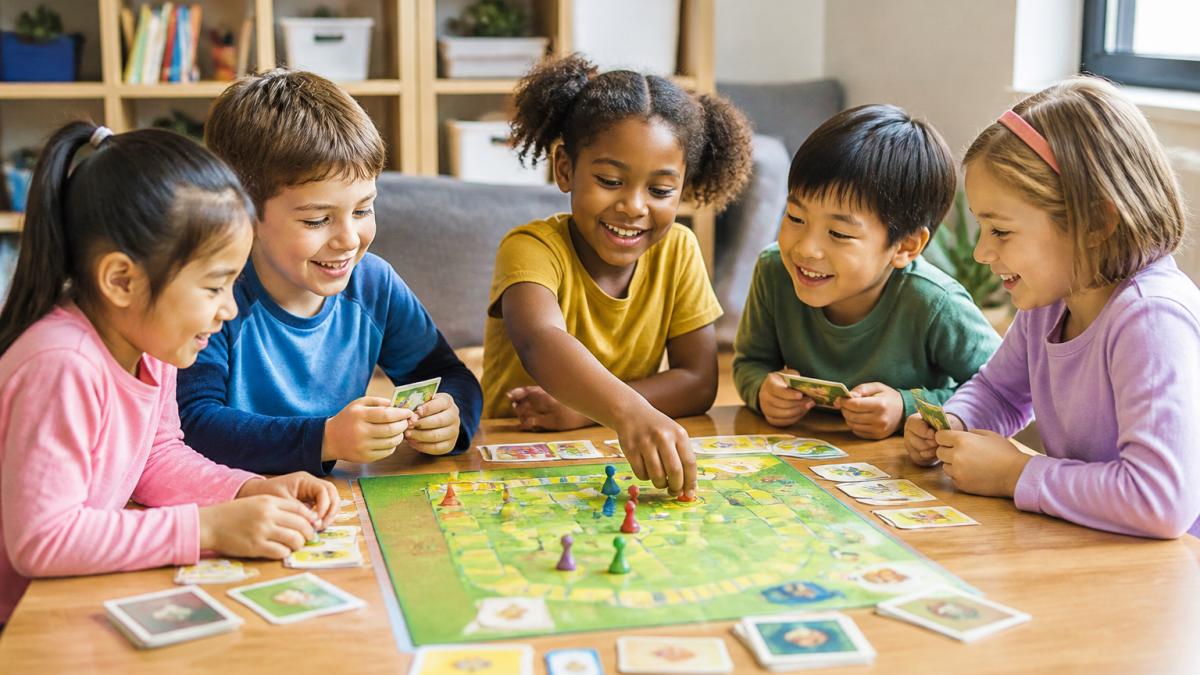
2. Dice and Board Games (Number Recognition and Addition)
Any board game with two dice is a math lesson in disguise. Your child rolls, adds the two numbers, and moves that many spaces. The adding happens out loud, every turn, without a worksheet in sight.
- Time: 15-30 minutes
- Materials: A board game, two six-sided dice
- Skill: Number recognition, addition facts to 12, turn-taking
- Easier: Use one die and count the pips aloud.
- Harder: Use three dice, or ask your child to say how many more they need to reach 12.
3. Pattern Detective (Early Algebra and Prediction)
Lay out a bead or block pattern, red, blue, red, blue, and ask what comes next. Then let your child build a pattern for you to solve. Patterns are the earliest form of algebraic thinking: a rule that repeats.
- Time: 10 minutes
- Materials: Beads, blocks, or colored buttons
- Skill: Pattern recognition, prediction, reasoning
- Easier: Two-color patterns only.
- Harder: Three-color patterns, or patterns that grow (1 bead, then 2, then 3).
4. Puzzles and Tangrams (Spatial Problem-Solving)
A 24-piece jigsaw asks a child to match shapes, colors, and edges, which is early geometry in disguise. Tangrams and pattern blocks add the same skill with a different feel.
- Time: 15-30 minutes
- Materials: A 24- to 48-piece puzzle, or a tangram set
- Skill: Spatial reasoning, shape recognition, persistence
- Easier: Start with a 12-piece puzzle or a framed puzzle with picture guides.
- Harder: Move to a 48-piece puzzle or ask your child to build a shape from tangram pieces with no outline.
Quick Reference
|
Activity |
Time |
Skill |
Cleanup |
|---|---|---|---|
|
Coin shop |
15-20 min |
Counting, money, addition |
Low |
|
Dice and board games |
15-30 min |
Addition to 12, turn-taking |
Low |
|
Pattern detective |
10 min |
Patterns, prediction |
Low |
|
Puzzles and tangrams |
15-30 min |
Spatial reasoning, shapes |
Low |
Educational Games for 6-Year-Olds That Build Critical Thinking
Educational games for 6-year-olds build critical thinking when they ask a child to plan, guess, or explain. The best ones have simple rules and more than one right answer.
Try these three:
- Twenty Questions. Your child guesses an object by asking yes-or-no questions. This trains logic and vocabulary.
- Pattern detective. Lay out a bead pattern and ask what comes next. Then let your child build a pattern for you to solve.
- Story fixer. Read a short story, then ask: “What would you do differently?” There is no wrong answer, which keeps kids thinking instead of guessing.
Screens are fine in small doses, but hands-on games keep a six-year-old talking, moving, and reasoning. That talk is where the thinking happens.
Learning Activities for 6-Year-Olds at Home: Arts, Crafts, and Building Games
Learning activities for 6-year-olds at home do not need a craft store. A table, some tape, and a recycling bin cover most of them. Art builds fine motor skills, the small hand muscles that later help with handwriting.
Three Concrete Projects (With Materials, Time, and Skills)
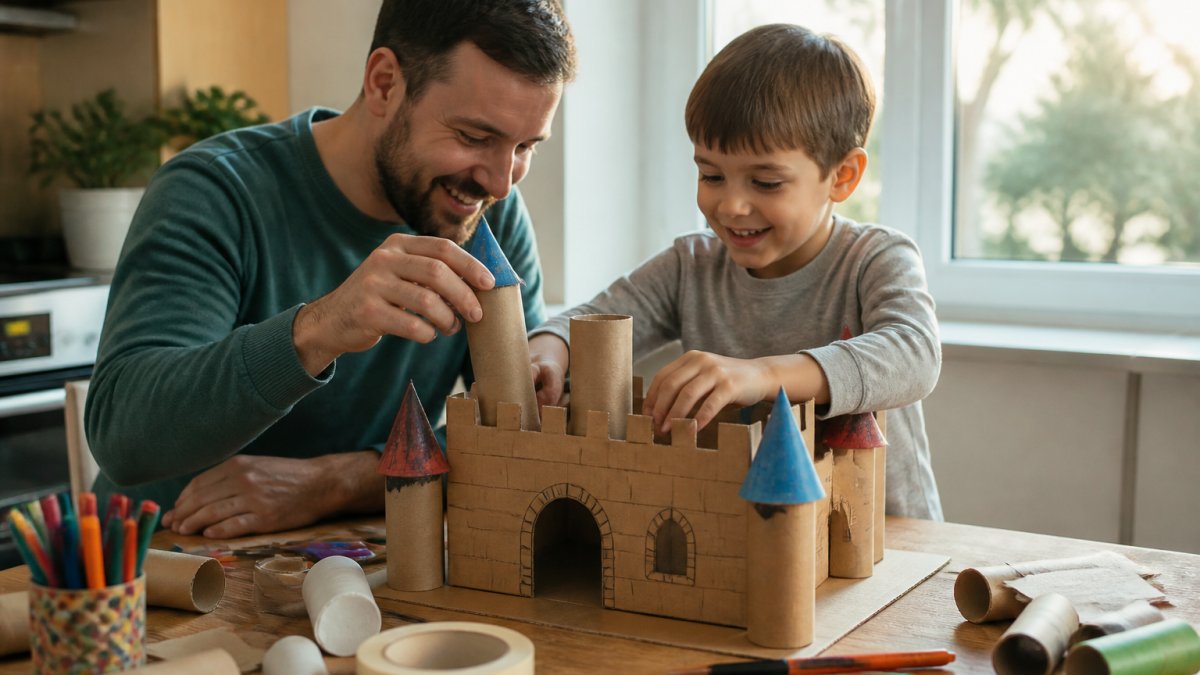
1. Cardboard Box Castle
Save a medium box, two cardboard tubes, tape, and markers. Your child draws a door and windows, cuts the tubes into towers, and tapes them on.
- Time: 30-45 minutes
- Materials: Box, 2 tubes, tape, markers, safety scissors
- Setup: 5 minutes
- Cleanup: Medium (keep a tray for scraps)
- Skill: Fine motor skills, planning, spatial reasoning
- Easier: Pre-cut the door and windows; let your child decorate.
- Harder: Ask your child to draw the castle first, then build what they drew.
2. Cardboard Tube Toy Car
A cardboard tube plus two bottle caps and a wooden skewer makes a rolling toy car.
- Time: 20-30 minutes
- Materials: Tube, 2 bottle caps, skewer, tape, markers
- Setup: 5 minutes
- Cleanup: Low
- Skill: Fine motor skills, cause and effect, persistence
- Easier: Tape the caps on instead of using axles.
- Harder: Ask your child to figure out why the car pulls to one side and fix it.
3. Shoe Box Puppet Stage
Cut the lid off a shoe box, turn it on its side, and you have a stage. Your child makes paper-bag or sock puppets and puts on a show.
- Time: 30-45 minutes
- Materials: Shoe box, paper bags or socks, markers, yarn
- Setup: 5 minutes
- Cleanup: Low
- Skill: Storytelling, sequencing, fine motor skills
- Easier: Let your child retell a story they already know.
- Harder: Ask for a story with a problem and a solution.
Adapting Crafts for Different Abilities and Learning Styles
Every project above can flex. A child who struggles with scissors can tear paper or use pre-cut shapes. A child who needs more challenge can add a second story to the castle or a second character to the puppet show. A child who needs sensory input can work with textured materials, yarn, felt, sandpaper, instead of smooth paper. A child who needs quiet can build alone at the table; a child who needs company can build with a sibling and split the jobs.
Screen-Free by Default
These three projects are screen-free. If your child wants to look up a castle picture first, that is fine, but the building itself is hands-on, which is where the fine motor and planning practice happens. A common pattern is that kids who build first and look up second stay engaged longer, because the idea is theirs.
Outdoor Activities, Movement Games, and Science Experiments
Outdoor play covers gross motor skills, science, and nature exploration in one block of time. A backyard, a park, or a sidewalk all work.
Movement games: Set up a simple obstacle course with pillows, cones, or chalk lines.
Science experiments: Plant bean seeds in a cup and track growth on a chart. Mix baking soda and vinegar to talk about reactions.
Nature exploration: A scavenger hunt works anywhere.
- Time: 30-60 minutes
- Supervision: An adult should stay close for climbing and water play
- Skills: Gross motor skills, observation, curiosity
Adapting Activities for Different Abilities, Time, and Group Size
Every activity here can flex. A child who struggles with writing can tell the story out loud instead. A child who needs more challenge can add harder words, bigger numbers, or a time limit.
Use this table to pick the right activity for your day:
|
If you have… |
Try… |
Why it works |
|---|---|---|
|
10 minutes |
Sight word hunt, dice math |
Fast setup, easy cleanup |
|
30 minutes |
Cardboard building, obstacle course |
Deep focus, movement break |
|
A group of kids |
Treasure hunt, twenty questions |
Turns take turns, no winner needed |
|
One child |
Story fixer, seed journal |
Self-paced, quiet focus |
|
A child with ADHD |
Movement games, short rounds |
Frequent wins, body stays busy |
|
A mixed-age group |
Art projects, nature hunt |
Same task, different skill levels |
For classroom use, run treasure hunts in small teams of four or five. For quiet time, swap movement games for puzzles and coloring.
Dewey Does has been igniting curiosity and making learning an adventure for children through a vibrant collection of engaging educational cartoon characters since 1999.
Conclusion
The hardest part of planning activities is not finding ideas. It is fitting them into a real day with limited time and energy. Start with one activity from this list, run it this week, and see what your child asks to repeat.
Dewey Does turns that first step into an adventure. Our educational cartoon characters, interactive games and puzzles, and creative coloring pages are built to keep kids curious.
Frequently Asked Questions
What do 6-year-olds like to play with?
Six-year-olds gravitate toward puzzles, building blocks, board games, and arts and crafts. They enjoy imaginative play, treasure hunts, and simple science experiments. At this age, they also like reading simple books, practicing sight words, and playing math games. Hands-on learning with household materials keeps them engaged longer than passive screen time.
How long should learning activities be for a 6-year-old?
Most six-year-olds focus best in 15- to 25-minute blocks. Short, frequent sessions work better than one long stretch. If your child stays engaged, let the activity run longer. If attention fades, switch to a movement game or a different hands-on task. Pairing a table activity with an outdoor break helps reset focus.
What indoor activities help 6-year-olds learn?
Indoor learning activities for 6-year-olds include board games that teach counting, puzzles that build problem-solving, arts and crafts that develop fine motor skills, and building games with blocks or recycled materials. Cooking together teaches measurement. Board games and card games reinforce number recognition. These screen-free activities support early literacy and math skills while keeping kids entertained.
How can I make learning fun for a 6-year-old?
Turn lessons into games. Use a treasure hunt for sight words, an obstacle course for counting, or a scavenger hunt for nature exploration. Let your child choose the activity when possible. Keep sessions short and celebrate effort. Hands-on learning with household materials often holds attention better than worksheets or apps, especially for kids who get bored quickly.