

Table of Contents
- Why Educational Screen Time Alternatives Matter
- Screen-Free Activities for Kids by Age Group
- Educational Activities for Kids at Home
- How to Reduce Screen Time for Kids: A Practical Transition Plan
- Things to Do Instead of Screen Time
- Making the Transition Stick: Common Mistakes to Avoid
- Frequently Asked Questions
Last Updated: October 18, 2026
Why Educational Screen Time Alternatives Matter
Parents today face a genuine dilemma. Kids need to learn, but endless screen time creates real problems.
At Dewey Does, we’ve been helping families navigate this exact tension since 1999. We know that screen-free activities for kids aren’t about eliminating screens entirely. They’re about creating balance.
The key insight most parents miss: replacement activities work best when they’re genuinely engaging, not just “less bad” alternatives. A child bored with a puzzle will beg for a tablet.
This guide walks you through practical screen time alternatives for kids that actually work. We’ll show you age-appropriate options, transition strategies that stick, and ways to build routines that don’t feel like punishment.
Screen-Free Activities for Kids by Age Group
Different ages need different approaches. A three-year-old’s brain works differently than a nine-year-old’s. Matching activities to developmental stages makes the difference between engagement and frustration. The table below pairs each stage with the specific skill it builds and the household materials that make it work without buying anything.
Ages 3-5: Building Foundation Skills
At this age, children learn through their senses and hands. They need activities that let them touch, manipulate, and explore. Simple doesn’t mean boring, it means focused. The goal is exploration, not achievement, so let them make messes.
|
Activity |
Skill it builds |
Household materials |
|---|---|---|
|
Cardboard-box play |
Spatial reasoning, storytelling |
Delivery boxes, tape, markers |
|
Sensory bins |
Fine motor, early math (pouring, volume) |
Rice, dried pasta, sand, spoons, cups |
|
Read-alouds |
Vocabulary, attention span |
Library picture books (free) |
|
Dress-up |
Social-emotional skills, language |
Old clothes, hats, scarves |
|
Large-piece puzzles |
Problem-solving, persistence |
8-12 piece puzzles already at home |
A common pattern: children this age repeat the same story or puzzle five times. That repetition is the learning mechanism, not a sign of boredom. Let it happen.
Ages 6-9: Deepening Learning and Independence
By age six, children can follow multi-step instructions and sustain focus longer. They’re ready for activities with measurable learning outcomes. Match the activity to the skill you want to strengthen.
- Literacy: Chapter books, graphic novels, and a daily 20-minute read-aloud. Let them write and illustrate their own comic using folded paper and pencils.
- Numeracy: Cooking and baking (measuring cups, fractions), board games with dice and money, and sorting coins from a jar.
- Problem-solving: Building systems (blocks, magnetic tiles), 24-48 piece jigsaw puzzles, and simple logic games.
- Motor development: Crafts with scissors, clay, and sewing cards; outdoor climbing and balancing.
- Science reasoning: Growing seeds in a cup, water displacement experiments with household containers, observing insects outdoors.
This age group thrives when they see results. They want to build something, finish a puzzle, or complete a story. That sense of accomplishment keeps them coming back, and it is the same mechanism that makes educational screen content sticky, minus the passive viewing.
Educational Activities for Kids at Home
Home is where most screen time happens, so it’s where alternatives matter most. The good news: you don’t need expensive equipment or elaborate setups.
Hands-On Learning with Household Materials
The best educational activities use things you already have. This removes the barrier of “we need to buy something first.”
Start with what’s in your kitchen and closet:
- Measuring and pouring: Water play with cups, funnels, and containers teaches volume and fine motor skills.
- Sorting activities: Sort buttons by color, pasta by shape, socks by size. This builds classification skills.
- Building with everyday objects: Stacking books, arranging pillows, creating structures from blankets.
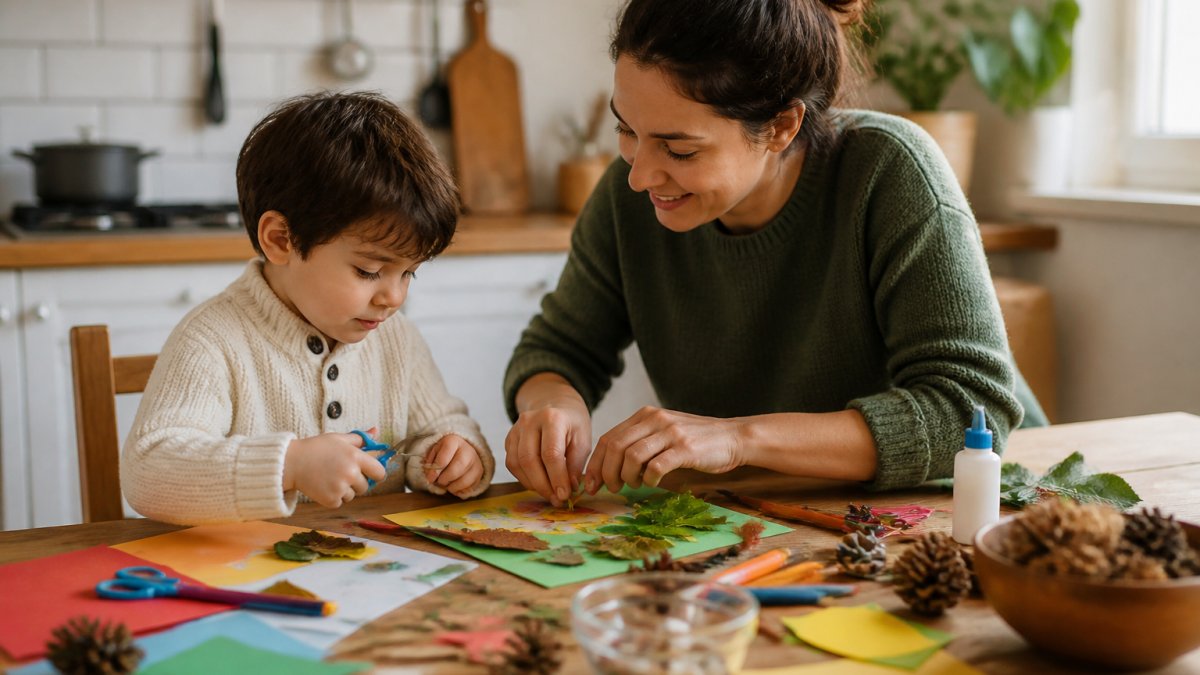
- Nature collections: Gather leaves, stones, and twigs. Sort them, count them, arrange them into patterns.
- Cooking projects: Let kids help measure, mix, and decorate. Baking teaches math and chemistry in a way they can taste.
The principle is simple: give children real materials and let them figure out what to do. Hands-on learning sticks better than passive watching.
Creative Arts, Crafts, and Storytelling
Creative activities build confidence and give children control. They decide what to make, how to make it, and what it means.
Practical screen-free activities for kids include:
- Open-ended art: Provide paper, markers, paint, and collage materials. No instructions. Let them create.
- Storytelling and skits: Ask “What if?” questions. Let them act out stories. Record them if they want.
- Greeting card making: Kids design cards for family. It’s creative, purposeful, and builds writing skills.
- Costume creation: Old clothes, fabric scraps, and accessories become costumes for imaginative play.
- Collaborative art projects: Large paper on the wall. Everyone adds to it over several days.
Creative activities have no “wrong” outcome. That freedom is what makes them powerful. Kids who spend time creating develop stronger problem-solving skills and more resilience.
How to Reduce Screen Time for Kids: A Practical Transition Plan
Cutting screen time cold turkey rarely works. Children resist. Parents get frustrated. The strategy that actually sticks is gradual, intentional replacement.
Step 1: Assess Current Screen Habits
You can’t change what you don’t measure. Spend three days tracking when and why screens happen.
Write down:
- Morning routine: Does breakfast include a tablet?
- Transitions: Do you use screens to manage transitions (getting ready for school, waiting at appointments)?
- Boredom response: When does your child ask for a screen?
- Evening routine: Is screen time part of bedtime?
- Rainy days: What’s your backup when outdoor play isn’t possible?
This isn’t about judgment. It’s about seeing the actual pattern. Most families find screens cluster around specific times: mornings, after school, or when parents need a break.
Step 2: Introduce Alternatives Gradually
Pick ONE time slot to start. Don’t try to replace all screen time at once.
For example, if screens happen during breakfast:
- Day 1-3: Keep the screen but add an alternative activity nearby (puzzle, coloring, building).
- Day 4-7: Offer the alternative first. “We’re going to do a puzzle during breakfast this week.”
- Week 2: Puzzle happens. Screen doesn’t.
Move slowly. One successful replacement creates momentum. Two replacements at once often fails.
Step 3: Build a Sustainable Routine
Once one time slot shifts, add another. Build routines that don’t require willpower every single day.
Effective routines include:
- Activity baskets: Keep puzzles, coloring, and building materials in easy-to-reach containers. Rotation prevents boredom.
- Toy rotation: Store half the toys. Rotate every two weeks. “New” toys feel fresh without buying anything.
- Scheduled screen time: Instead of “no screens,” try “screens after dinner.” Predictability reduces conflict.
- Family activity time: One hour together without screens. Walk, cook, build, play games.
- Outdoor time: Fresh air and movement naturally reduce screen requests.
Routines work because they remove daily negotiations. Kids know what happens when, and that predictability actually reduces resistance.
Things to Do Instead of Screen Time
When a child says “I’m bored,” they’re often just seeking engagement. Here’s what actually works.
Outdoor and Physical Activities
Movement is non-negotiable for child development. Active play builds strength, coordination, and emotional regulation.
Practical options include:
- Walking and hiking: Explore your neighborhood or local trails. Collect things. Notice details.
- Biking: Start with tricycles or balance bikes. Progress to pedal bikes.
- Sports and games: Soccer, basketball, tennis, or just running and tag.
- Climbing and jumping: Playgrounds, climbing trees, or backyard obstacle courses.
- Water play: Sprinklers, hoses, or kiddie pools on warm days.
- Yard work: Digging, planting, raking. Kids love doing “real” work alongside adults.
Physical activity does more than burn energy. It improves focus, reduces anxiety, and builds confidence (the CDC). A child who’s had active play time is more likely to engage with screen-free alternatives.
Puzzles, Games, and Educational Toys
The right toys hold attention without screens. Look for toys that invite problem-solving and creativity.
Strong options include:
- Puzzles: Start with 4-8 pieces at age 3. Progress to 24-48 pieces by age 8.
- Building systems: LEGO, magnetic tiles, blocks, or construction sets.
- Board games: Candy Land and Chutes and Ladders for ages 3-5. Checkers, Connect Four, or Uno for ages 6+.
- Card games: Go Fish, Snap, or simple matching games.
- Educational toys: Pattern blocks, tangrams, or logic games that teach spatial reasoning.
The key is variety. Rotation prevents boredom. Dewey Does offers a range of educational activities designed to hold attention through actual engagement, not flashy graphics. Our characters and stories create context for learning that kids genuinely enjoy exploring.
Books, Reading, and Imaginative Play
Stories are powerful. They build vocabulary, imagination, and emotional understanding in ways screens rarely do.
Reading and storytelling activities include:
- Picture books: Read aloud daily. Let kids pick books. Repeat favorites without complaint.
- Chapter books: Start around age 6. Read aloud together. Let them follow along.
- Graphic novels: Visual storytelling appeals to many kids who resist traditional books.
- Audiobooks: Listen while doing other activities, car rides, walks, craft time.
- Story creation: Ask “What happens next?” Let kids tell stories. Write them down.
- Dress-up play: Costumes spark imaginative scenarios and storytelling.
Reading creates a foundation for all learning. Kids who spend time with books develop stronger language skills and more curiosity about the world (Parents’ early book reading to children).
Making the Transition Stick: Common Mistakes to Avoid
Common mistakes to avoid:
Mistake 1: Replacing screens with “educational” apps
This isn’t actually reducing screen time. It’s just different content. Real alternatives are hands-on, physical, and creative.
Mistake 2: Introducing too many changes at once
Kids resist big shifts. Pick one time slot. Make it work. Then expand. Gradual change sticks.
Mistake 3: Offering boring alternatives
A child will choose a screen over a dull activity every time.
Mistake 4: Inconsistency
“No screens today, screens are fine tomorrow” creates confusion and resistance. Routines work because they’re predictable.
Mistake 5: Not addressing parental screen time
Kids notice. If you’re constantly on your phone, they will resist your screen-time limits. Model the behavior you want to see.
Mistake 6: Ignoring individual differences
Some kids need more physical activity. Others need creative outlets. Match activities to your child’s actual interests, not generic recommendations.
Reducing screen time for kids isn’t about deprivation.
Dewey Does has been helping families make this transition since 1999.
Frequently Asked Questions
How do I help my child transition from screen time to another activity?
Start by replacing one screen session at a time with a specific alternative—for example, swap afternoon tablet time for a puzzle or outdoor play. Introduce the new activity before removing screens, so your child has something to look forward to. Use timers to make transitions predictable. Pair the activity with something your child enjoys (like a snack or your full attention) to build positive associations. Most children adapt within 2-3 weeks of consistent replacement.
What are some easy learning activities kids can do without screens?
Puzzles, building with blocks, coloring and drawing, cooking simple recipes together, nature walks, reading aloud, dress-up play, and hands-on science experiments all build skills without screens. Younger children (3-5) benefit from sensory activities like playdough and water play. Older kids (6-9) enjoy building projects, board games, and creating stories. Many of these use household materials and cost little to nothing.
How can I make screen-free activities educational and fun?
Choose activities that match your child’s interests and developmental stage. Combine learning with play—for example, cooking teaches math and following directions, while nature walks teach observation and vocabulary. Ask open-ended questions during activities (‘What do you notice?’ ‘What happens if…?’) to deepen learning. Rotate activities to keep things fresh. Educational activities feel less like ‘learning’ and more like adventure when they’re hands-on, creative, and done together.
What age should a child start with educational screen time alternatives?
Screen-free alternatives are beneficial at any age, but the American Academy of Pediatrics recommends minimal screen exposure for children under 18 months and high-quality programming for ages 2-5. Starting screen-free activities early (ages 3+) helps children develop attention, creativity, and motor skills. Even infants and toddlers benefit from hands-on play, books, and outdoor time. The earlier you establish screen-free routines, the easier they become part of your family’s daily rhythm.